Classroom · Kindergarten–Grade 5
Meaningful Learning for K–5. Stronger Connections Beyond the Classroom.
A digital learning solution that brings Reading and Math together with meaningful family engagement.
Built for schools and educators, with tools for instruction, differentiated learning, and continued learning at home. Nonprofits and community organizations can bring these resources directly to the families they serve.
- Reading + Math
- Classroom + Home
- Learning that connects

Every child deserves the chance to learn and grow
A child discovering the joy of reading. A student finally understanding a tough math concept. A teacher reaching a struggling learner. A parent helping with practice after school. These moments shape confidence, curiosity, and a child’s relationship with learning.
Meaningful learning shouldn’t stop when the school day ends, and access shouldn’t depend on which school a child attends or what’s available at home.
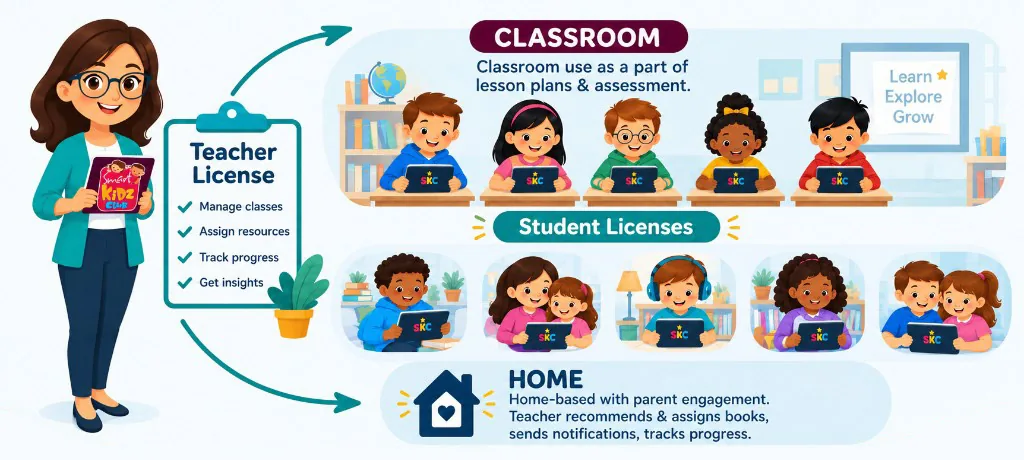
A learning partner for schools, educators, and communities
Teachers
Introduce resources, reinforce concepts, assign activities, and monitor engagement.
Children
Explore books, practice skills, and learn at their own pace.
Families
Continue learning beyond the classroom.
Community organizations
Extend educational opportunities to the families they serve.
| A common digital-learning approach | Smart Kidz Club approach |
|---|---|
| Focus on a single learning area | Reading + Math |
| Primarily classroom use | Classroom + home connection |
| One-size-fits-all learning | Resources that support differentiated learning |
| Content access alone | Content + guided learning opportunities |
| Learning ends with the school day | Opportunities to continue at home |
| Separate resources to manage | Reading and Math in one solution |
Two essential learning areas. One connected solution.
Reading: build skills, confidence, and a love of learning
Resources for developing readers to explore stories and discover new ideas. Educators can:
- Encourage reading practice and comprehension
- Introduce vocabulary and knowledge
- Support read-aloud and independent reading
- Reinforce classroom themes
- Recommend and assign books suited to student needs
- Encourage reading at home
Math: make concepts more accessible
Math resources alongside Reading help children recognize patterns, solve problems, and think logically. Educators can:
- Reinforce concepts from instruction
- Provide more opportunities to practice
- Support different proficiency levels
- Help children build confidence
- Extend learning beyond the classroom
- Keep families involved
Reading builds language and understanding. Math develops reasoning and problem-solving. Both help children become confident, capable learners.
Give teachers more ways to support every learner
Resources that complement instruction without adding complexity.
Assign and recommend
Select books and activities that fit classroom topics and individual student needs.
Differentiate learning
Match resources to reading abilities, learning needs, and proficiency levels.
Independent exploration
Let students practice and explore at their own pace.
Reading accessibility
Read-aloud and text highlighting help children follow along while listening.
Activities and quizzes
Encourage engagement and check comprehension.
Engagement reports
Use reading activity data to inform teaching and spot who needs support.
Offline access
Keep learning going where internet access is unreliable.
Learning doesn’t end at the classroom door
Families may not know what their children are learning, which resources to use, or how to help when a concept feels hard. Smart Kidz Club helps educators build a bridge between structured learning and everyday family life.
We don’t see parents and caregivers as spectators. We see them as learning partners. Families don’t need to replace teachers or become experts; they need practical ways to take part.
Educator or facilitator
Introduces, recommends, encourages.
Family
Explores, practices, talks, supports.
Child
Reads, understands, practices, grows.
Read together
Explore books and talk about new words and ideas.
Practice together
Reinforce concepts with educational resources.
Discover together
Encourage questions and curiosity.
Build confidence together
Celebrate effort and small breakthroughs.
Make it a habit
Turn everyday moments into learning moments.
One solution. Many learning environments.

In the classroom
- Assign and recommend resources
- Reinforce lessons and themes
- Support different reading abilities
- Use activities and quizzes
- Review reading engagement

At home
- Read and listen together
- Practice skills and revisit concepts
- Discover new topics
- Build regular routines
- Celebrate growing confidence

In the community
- Bring Reading and Math to families
- Complement after-school programs
- Support family literacy initiatives
- Strengthen links among programs, educators, and families
Bring meaningful learning to the children and families you reach

- K–5 schools and districts — foundational Reading and Math, extended to students’ homes.
- Teachers and educators — practice, differentiation, and engagement tools.
- After-school and enrichment programs — purposeful learning outside regular hours.
- Nonprofits and community organizations — resources delivered directly to families.
- Libraries and literacy organizations — digital reading that complements existing programs.
- Family engagement initiatives — accessible ways for caregivers to take part.
One learning solution. Many needs.
Every child learns differently and every community has its own priorities. Read-aloud, text highlighting, and resources for different needs give children more ways to engage. The solution complements educators’ work; it doesn’t replace teacher guidance, individualized instruction, or family relationships.

Particularly relevant for
- Children building foundational reading skills
- Students who benefit from extra reading practice
- Children with different learning abilities and needs
- Students who benefit from narrated reading and text highlighting
- Families seeking more resources at home
- Children who need to revisit concepts at their own pace
- Communities expanding access to educational content
A practical approach for schools and organizations
Understand your needs
Discuss goals, student population, grade levels, and learning priorities.
Plan your implementation
Identify participating grades, classrooms, educators, or families; explore content alignment and access needs.
Prepare educators and facilitators
Introduce features such as assigning resources, learning activities, and family participation.
Connect with families
Help caregivers access resources and build learning routines.
Encourage ongoing engagement
Use engagement information to find opportunities for support.
Provide ongoing support
Discuss technical and implementation support suited to your arrangement.
A purposeful approach to digital learning
- Reading and Math in one solution
- Designed for K–5 learners
- Tools for educators
- Opportunities beyond the classroom
- Support for diverse learning needs
- Purposeful digital experiences—no harmful advertising or distracting videos
- Flexible community applications
- Support for implementation
| Other approaches may emphasize | Smart Kidz Club emphasizes |
|---|---|
| Content access | Content with educational purpose |
| Reading alone | Reading + Math |
| Individual screen use | Learning with educator and family support |
| Classroom-only implementation | Classroom + home + community |
| More screen engagement | More meaningful learning |
Frequently asked questions
What is the Classroom Solution?
A digital resource for schools and educators serving K–5 students. It brings Reading and Math together with features for instruction, learning activities, resource assignment, and engagement. Nonprofits and community organizations can also bring it to families.
Which grades does it serve?
Kindergarten through Grade 5. Discuss participating grades and requirements with Smart Kidz Club.
Does it include both Reading and Math?
Yes, both, in one solution.
Who can use it?
K–5 schools and educators, plus nonprofits, libraries, after-school programs, and community organizations.
Can teachers assign resources?
Yes. Teachers can recommend and assign books based on student progress.
Can it support different learning needs?
Features include read-aloud, text highlighting, and resources for different learning needs to complement differentiated instruction.
Can children learn at home?
Yes. Educators and organizations can help families access resources and keep learning beyond program hours.
Does it work offline?
Yes, books and resources can be downloaded for offline use. Confirm device compatibility and access requirements for your setting.
Does it align with our curriculum?
Alignment with U.S. Common Core State Standards and curriculum mapping are part of implementation. Discuss grade-level priorities with Smart Kidz Club.
How is it implemented?
It starts with your requirements: participating grades, curriculum mapping, access, educator onboarding, family outreach, and technical support.
How do we get started?
Contact Smart Kidz Club with your students, grade levels, priorities, and number of classrooms or families served.
Can teachers track student reading activity and progress?
Yes. Teachers can monitor individual student and class-wide reading activity, including books read, time spent reading, reading levels, book categories, and completion of assigned books. Educators can view overall class engagement as well as detailed progress for each student. Teachers can also monitor the class leaderboard, where Smart Coins earned through app activity and engagement recognize student participation and encourage reading.
Bring meaningful learning to more children
Let’s help more children build the skills, confidence, and curiosity they need to keep learning and growing.
Request a Demo
Ready to bring Smart Kidz Club to your school or community?
Serving children before kindergarten? See the Early Learning Library.